Blog

  • for the times….

    Press play for the audio recording of this blog

    An old friend messaged me to say that they had been reading my blog (this blog) I had forgotten that I had a blog if I’m totally honest 

    A nice remembering that made me think how good it would be to write another post. 

    I realise that I seem to come back here during phases of liminality, when the world I knew and the yet to come appear so intractably distant that bridging seems more a leap of faith than an actual engineering possibility. Maybe there is something in claiming that gulf through the eyes of unknown readers that helps me process. Or maybe that I’m just a massive narcissist without the ready audience of a team of people paid to listen to me and so this becomes the pill. Either way. Here I am, trying to find the shy words that lull at the deepest recesses of my knowing to answer the question that keeps arriving in my DMs – so where are you now?

    Where I am

    Well easy enough, sitting at my desk, typing at my keyboard, the same desk and keyboard and monitor that I wrote the Management Plan on and that I answered emails for the woodland trust from (albeit for a shorter time). a desk, an orange seat, an attic, surrounded by books.

    I don’t think that is what the ask is though.

    I think what people are asking is where does this computer point at? who pays the hands to type out words for them?

    And that is more difficult to put into words.

    No one and everyone.

    your sons and your daughters are beyond your command

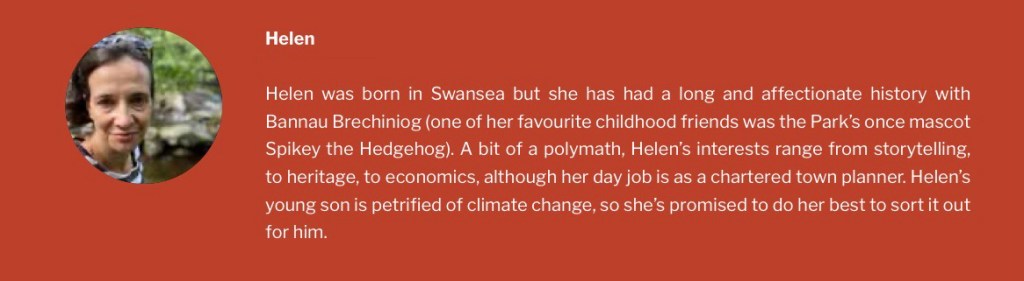
    Many of you know me from the work I did as lead author of a Management Plan for Bannau. It was a policy  document like no other for many reasons, but mostly because my co-writer Jodie and I believed it needed a really strong narrative arc.  It should start with the legacy National Parks inherited from their inception to be resources for the nation in need of healing after the second world war. and end with the start of a different legacy.  Very purposefully I wanted the last lines left hanging with the reader to just be a small moment of insight about why the words of the plan mattered. They were personal, but they were also way bigger than me.  Here they are 
    How I do it though, no such glib exclamations of saviour mother, I live each day with no expectations of any achievement other than to have gotten through the day. 

    That young son, no longer exists.  They are now a beautiful wonderful clever fourteen year old whose amazing neurodivergent brain has found much of the world around them uncommonly fascinating and unbelievably frightening.  Full of assumptions that do not add up, that hurt and terrorise, that subjugate and destroy I have watched them slowly disappear as they attempt to navigate a world built for neuro typical minds. 

    It hurts to watch the destruction of such wonder.  A grief that overpowers as the  silent retreat into themselves deepens. 

    and don’t criticise what you don’t understand

    About 18months ago my eldest child agonised with something they needed to tell me.  They were 12. 

    Up until that point in time they had been a happy enough kid. In many ways extraordinary, in most ways normal.

     I always thought that they were an old soul, like they looked at the world like they had seen it before and in a way already knew all the things they wanted to know. Like it was nothing new.  They were talking in full sentences by 2.  Reading by 3.  Reading maps by 5.  They sounded like a little old man.  They loved the company of adults, reading stories, riding on trains, his reception teacher told me that they used to just sit and chat . As they grew older each year their teachers would call us in, once we had a teacher who suggested that they believed our child was hearing voices and emotionally disturbed. Another who suggested that they may need glasses because they kept getting up and wandering about, another who suggested that my request for an autism diagnosis (first raised with the ‘wonderful character’ teacher) was probably a good idea because she was actually struggling. 


    Mostly though just a geek kid doing geeky things, having fun with their geeky friends.  Loving and kind, a worrier, the most amazing imagination, a believer in magic.

    But things had started to change as they headed into year 8.  They seemed to be less interested in their friends, had periods of complete withdrawal from the world. And most distressingly their self soothing stimming ticks had progressed from hand wringing to physical aggression towards themselves.  We would see a disturbing level of self admonishment, of constant apology, of real self directed vitriol.  We spoke to the school about the ND assessment (they had been on a waiting list for assessment for four years by this point) and it was agreed for additional support to be put into place regardless of the diagnosis. Problem solved. 

    And then April 2024 on a family day out in Dyffryn Gardens it felt like we’d hit some kind of crisis. They kept saying, Mum I’m…. And then just freezing.  For anyone who knows me and my overly active ADHD will know that I attempted every way I could to finish that sentence, each time I offered a solution, their frustration would grow and again, ‘ no listen Mum I’m’  – silence. This went on for days and days with the frustration they felt spilling out into every interaction, every thread, each elements of family life.  It felt like living in a Samuel becket play. Resolution was nowhere to be found. 

    Finally after about a week of the stop start confessions,  they showed me a drawing in their sketch book, a sort of anime style quirky hair, eyeballs and bows, the name Sophia was written above the image.  I know that this is a cliché but in that moment I just knew, maybe it was the look on her face, it was the same as the desperation to talk as the days of stunted explanations, maybe it was the hope that finally flickered there too.  But as soon as I saw the picture I knew.  

    ‘Is this you?’
    A nod, and a look of deep deep shame
    ‘Do you want me to call you Sophia now?’ 
    ‘Sorry’ quietly offered to me under heavy heavy tears.

    Now I wish I had something really profound to tell you about my reaction. 

    I was both in shock at the realisation that my son was telling me that they wanted to be something totally different,  and huge relief that they weren’t attempting to tell me that they had killed a kitten or something equally abhorrent over the past few days of stuttering revelation. 

    I cannot remember what I said, it may have been thank fuck I thought you’d killed a kitten. It may have just been a hug. All I know is that everything changed from that point. 

    please get out of the new one if you can’t lend your hand

    I reverted to type and researched the hell out of trans kids and I read many many first hand accounts of both growing up trans and raising trans kids.  This from Carolyn Hays is by far the words that have been most instrumental to me in that journey

    A statistic. … one that finds almost every parent of a transgender child, one way or another. The suicide attempt rate. At the time, the stat was that 46 percent of trans people had attempted suicide at some point in their lives. For the general population, that rate is less than 2 percent. I’ve kept my eye on this stat over the years. I’ve seen it range from 41 percent to 47 percent, and when broken down, I’ve seen it as high as 51 percent for trans boys and men. Now there is really clear research that explains how to bring that statistic down to the below 2 percent of the general population. It’s this: acceptance, support. If parents, schools, faith communities, neighbors, and relatives shift pronouns, let the kid decide how they need to present themselves to the world — hair, clothes, name — the risk of suicide for that child plummets.

    and so their old identity became known as ‘the redacted’ and we begun systematically replacing the child Dylan I thought I birthed, with the person she was learning she was.  The bag of eyeballs and bows that started off as Sophia on a shaky notebook, morphed into Deska a hoody wearing non-binary , and now is currently known as Nell.  Nell has fully socially transitioned, including in school,  and identifies with the she/her and they/them pronouns.  She says ‘I’m like 75% female right now’ although to me she is just 100% themselves 

    That is where the bits of the story I can easily explain end. 

    The rest is a spaghetti like jumble of threads that all seem to lead nowhere and everywhere at once, but mostly to this place.

    I have left my paid job as nell cannot attend mainstream school anymore, I support her in homeschool which mostly now happens online.  This is not because of the school, they have been amazing.  Shout out to Delyth.  We love you.

    No it is because gender dysphoria is so crippling to them that they live their lives in a deep cloak of shame and anxiety that prevents them from feeling worthy of engaging in normal life. Have you ever watched a child so desperate to join in and be normal and hang out with other kids, and yet so unable to find the way that they freeze in fear and sadness and you as a parent have to stand and watch, physically and mentally unable to make any of it better.  

    This is all exacerbated by the challenges of intersecting diagnosis.

    Nell is as both neuro and gender diverse. Which it turns out is not that uncommon.  Again some stats – gender diversity in the general population falls between 1 and 2%.  Whereas amongst autistic population a much higher prevelance is observed, with studies placing it anywhere between 10-35%.

     However, the support available to Nell under CAMHS is either additional learning support for autism (which Nell describes as dehumanising and belittling) or talking therapy for the gender dysphoria (see above for the difficulty Nell has in communicating how she feels in words).  And because neither have provided the help that Nell actually needs we seem to be at some sort of impasse where the educational welfare officer writes to ‘the parent/or guardian’ to threaten £2,500 worth of fines with about as much empathy for the repeated trauma our family is experiencing as a wet fish. 

    the line it is cast

    There is a story I found recently, tucked away in an old copy of The Womanly Art of Breastfeeding, first purchased when I became a mother all those years ago that resonated in its totality.  

    A mother explains what it felt like to find herself unexpectantly birthing a child with physical disability,  she describes it like a trip to Italy that gets diverted. You pack your bags for the Coliseum and the gondolas, she says,, you learn the phrases, you buy the guidebooks. But when the plane lands, the stewardess tells you: “Welcome to Holland”.  

    Holland is slower. It’s less flashy. But she reflects if you spend your life screaming that you were supposed to be in Italy, you will never see that Holland has windmills, and tulips, and Rembrandts.  

    I am learning to walk in Holland. I am learning to put down the guidebooks for the child I thought I had, and simply sit with the one who is here as we both learn how we can survive in this new world together

    This brings me back to the desk, and the orange chair, and the question of “where are you now, what do you do?”

    I am no longer the person with the extension number. But I am also not disappeared.

    In stepping away from the 9-to-5, I have carved out a different kind of space. The part of me that needs to work—the part that thinks in systems and writes in strategies, that you may want to tag in a LinkedIn post, or talk an idea through with —is still very much here, still very much needs to be listened to.

    But now, that part of me I see as a far more  precious resource, one I can no longer afford to spend on things that do not matter.  In the coming weeks I’ll be posting more about that person her work and her wonderful CIC with the beautiful and brilliant Jodie Bond at Landed futures.  How the flexibility of freelancing has provided me with the necessary space to be all that I need to be.  But for now I felt it important that I make this truth known to the world. 

    It will form a massive part of who I become and the person you will hopefully stay in touch with as I learn to read a different map, for the times they are a changin’

    With love and apologetic thanks to the many Dylans in my life for helping me anchor these words to the page.

  • The conversation that never happened

    <Prefer to listen – you can hear a recording of me, inexpertly reading these words below>


    I

     National Parks in the UK emerged from working class struggle,

    I know that might seem strange, especially now, when the word National Park seems to be synonymous, with white middle class privilege.

    A memory comes to mind,  a one time CEO of a prominent English National Park telling the Guardian that his visitor profile was hideously white and hideously middle class, there was some backlash,  although for those of us working on the inside, an uneasy truth was exposed.

    It wasn’t always that way though.

    Once visiting countryside (later to become National Parks or National Landscapes for a  ‘ramble’ was a radical act.

    In post millennial understandings, where it is the extremity of the pursuit that seems to grab the attention, the phrase to ramble feels on a completely different end of the spectrum –  a bit comical – the sort of thing genteel pipe smoking men in flat caps and tweed breeches did in Enid Blighton novels.  Nothing extreme about a ramble.  I have to admit that there is a bit of me that had absorbed that perception too.  As a outdoor enthusiasts of the Trail generation,  I would have scoffed at rambling as radical, or in anyway political. A ramble was the sort of thing you had to do when you were injured and couldn’t climb, or you were reluctantly having a rest day.

    Rambling as a hobby was not going to get you a sponsorship deal with redbull, or secure your kudos as a radical outdoorsy type.  

    But it might have once, 

    Once going for a ramble politicised the working class providing a tangible form of resistance against social and economic inequalities

    The story of the Kinder Trespass may be the best known of this action. Best known for the brutality, the harsh punishments handed out by the establishment to those ‘ramblers’ who were walking on the moor, for the ripples it sent through the nation to the eventual legislative change in the National Parks and Access to the countryside Act  that passed 17 years later.

    But it was, in many ways the culmination of a growing conflict between those who had, and those who didn’t.

    The Kinder Trespass took place in 1932, organised by a loose alliance of socialist and communist factions from the urbanised North.  Young men and women, politicised by their circumstances, who found release in affordable bus rides to the surrounding Pennines, or Peaks to spend a day walking in a countryside that felt like the antithesis of the industrialised world that made up their day to day.

    It is a story I know from my parents, and their love for the English folk revival.  One song that seemed always to be playing on the squeaky tapedeck of our musty aged camper van was Ewan MacColl’s Manchester Rambler.

    DDMW69 Ewan MacColl, Enterprise Public House

    The song, considered to be one of MacColl’s finest, starts as a kind of love song to the open hill.  MacColl Recounts his travels across the Uk,

    I’ve been over Snowdon, I’ve slept upon Crowdon
    I’ve camped by the Waynestones as well
    I’ve sunbathed on Kinder, been burned to a cinder
    And many more things I can tell,’ 

    The chorus, true to genre, is a catchy refrain that, despite your inner cool, you find yourself singing along to by about the second time of hearing it.  Genuinely its earworming its way into my head right now, apologies if its doing the same to you too. In memory, I cringe with the recollection, the four of us, mum, dad, sister, me, singing in tuneless harmony as our plum red bedford van chugged its way across the welsh hills.

    I’m a Rambler, I’m a rambler
    From Manchester Way
    I get all my pleasure the high moorland way
    I may be a wage slave on Monday
    But I am a free man on Sunday

    The song then continues to retell the story of MacColl’s involvement in the Kinder trespass itself, how gamekeepers to quote MacColl with the teeth of of his fury bar access to the rambling congregation by barking at them ‘this land’s my masters’.  To which the rambler narrator stands ‘shaking his head’ and speaks the words that stuck with me the most to this day, no man has right to own the mountain.

    2M3NGMD MASS TRESPASS OF KINDER SCOUT

    The final verse seems as pertinent now as it was almost 100 years before, although sadly the wildlife referenced marks it out as belonging to another time.

    So I’ll walk where I will over mountain and hill
    And I’ll lie where the bracken is deep
    I belong to the mountains, the clear running fountains
    Where the grey rocks lie ragged and steep
    I’ve seen the white hare in the gullys
    And the curlew fly high overhead
    And sooner than part from the mountains
    I think I would rather be dead. 

    National Park’s in the UK, are rightly proud of the egalitarian beginnings of their genesis.  It is a far cry from other international campaigns, which focused on the preservation of wilderness,  focused on the need to exclude people in the search of a pristine nature to survive. 

    The UK did not follow this path, unlike in other nations the designation of National Parks did not mean compulsory purchasing of land, or clearance of communities from within their borders, they simply meant a recognition of the importance of access to open countryside to the nation.  The movement focused on restricting urbanisation, and promoting access, to quote Dame Fiona Reynolds, it was a fight for beauty.

    In the UK the class and wealth divisions exposed within the fight to access the countryside, resonated within a far greater national and political awakening to fundamental inequity.   The emphasis on the basic right of every citizen to have fair access to natural beauty found common ground with similar campaigns born out of the economic depressions of the 1930s.  Campaigns focused on the right to good housing, education, food, welfare, health provision. 

    As with all movements that shake up the status quo and bring about change it was crisis that created the space for decisive responses.  In this case, the Second World War and its aftermath which provided the pivotal moment through which such ideas could gain popular appeal within the electorate.  Blitz spirit, writ large.  As the Nation rebuilt itself after the war, the state began building a more equal society through various acts of parliament which would essentially create a network of universal basic services including the National Parks and Access to the Countryside Act.

    Apologies if you know this already, if this is no new story, and you can (if you google) find versions of this story on the official websites and publications of all designated landscape official bodies and support groups.

    There is a bit that keeps being left out though, not on purpose I’m sure, we just forget.

    And that is ok I guess, its just as we find ourselves lurching towards the creation of more National Parks across Scotland, England and Wales, I think its time that we remembered. 

    It’s hard to unpick in its entirety, and even though the myriad of words that follow attempt it, I’m not sure that I quite get down to the roots of it all, but its a start at thinking about the conversation that never happened.

     II

    National Parks are national, that is they are designated in the national interest, to provide opportunities for greater understanding and enjoyment of these areas natural beauty and importance as landscapes of outstanding value –  Britain’s breathing spaces  to quote a one time marketing campaign for designated landscapes.

    A National Resource for nature and people, replete with managing authorities created to ensure that the area within the Park’s boundaries uphold this ethos.

    Only the slight flaw in this plan, this national resource has been created from mostly privately owned land over which such authorities have very limited powers.

    This is the point right, the plucky working man standing up to the lord of the manor.

    Only maybe that isn’t the entirety of the whole truth.  Whereas we may be able to recognise that there was a fundamental inequity in the restriction of access to vast sways of moorland because a lord of the manor didn’t want the grouse he was rearing to shoot for fun to be disturbed before they were driven by dogs to be blasted out of the sky by him and a bunch of his friends – the inequity is less clear -for the majority – most of such areas that were designated for the peoples enjoyment – especially in the marginal uplands which dominate National Park landscapes – were actually small family farms, managed mostly on a subsistence basis for food production, handed down from generation to generation, the good v’s evil trope feels to fall spectacularly short.

    The British government, may not have cleared indigenous communities from within their designated lines as was seen in Yosemite and Yellowstone, but there was in the designating committees that defined the final boundary line, a power imbalance that worked a different kind of subliminal imperialism.  The England and Wales, designation boards, we know consulted on detail rather than involved proactive discussion on principle. One history of the National Park movement described the passing of designation into law as the day the ‘Peak District opened its gates.’  A strange but pervasive view of the reality of National Parks because there are no gates to open, no ribbons to cut.  The change was more subtle.  A shift in power dynamics in these areas, a shift, which if we had stopped to think it through more clearly, we may have seen a deeper folk memory bubbling to the surface, of earlier moments of enclosure, of taking of land by those in power for the benefit of someone other.  

    In the process of designation, which was clearly a top down imposition, an uneasy tension developed, a tension between two perspectives of the countryside.  Perspectives  formed at one end of the divide  from the outside looking in. A perception based on form not function, which saw in these areas vast natural spaces so precious they must stay just as they are.  At the other end there were those whose lives looked out from this land, who saw the productive function of the the green fields and valleys, the product of their and their families before them hard graft, their sustenance and their livelihood.

    The positions polarised.  

    It became a dualistic narrative: urban associated with progress, innovation, technology, civilization, knowledge creation. The country, provincial, conservative, simple, insular, a culture dependent on others to patronise it for the best outcome. 

    Just like the town and country mice of children’s story, neither understood each others world enough to survive.

    III

    I’m simplifying of course.

    The point is that once upon a time National Parks were created for the best of reasons, but the wrong that was supposed to be righted in their creation, this great egalitarian legacy, was unwittingly and ironically perpetuated as people with power, determined a different purpose for the land of many marginalised people.

    Here in Wales that connection felt by those who have for generations managed the land is visceral, it is something that is felt rather than known.  The entwined nature of a relationship of people and land, is difficult to quantify, and those far more expert than I, have written at length about this relationship. We have words like Cynefin and Hiraeth, all without direct translations that edge at it.  Suffice to say that many of the farmers within the boundaries of Welsh National Parks, had far more in common with the values and sentiments of MacColl’s Rambler than the Master the song rails against.  I think of the words in that final verse, ‘I belong to the mountains…and sooner than part from the mountains/I think I would rather be dead’ and I think not only of my own relationship to this land, but also those who I have met on farm, who talk of the land as if it actually owns them, that they serve it.

    But…

    In the process of designation assumptions of universal benefit guided decisions. And that created a tension with those who previously had concerned themselves with private interests.   From where I stand, a veteran of National Park policy making, it is this tension which frames the collective memory of those generations of traditional farmers and until its addressed we are stuck in a culture war that will destroy us.

    It was a  tension I had encountered  many times before but I’d pushed to the margins in that dismissive way some of us have when we encounter ideas that run contrary to our own – my immediate family loved and enjoyed the access to the countryside National Parks and Designated Landscapes offered us (the urbanised) My paternal Grandfather (rural) had very different views however.  Ivor Ronald born on Gower at the beginning of the 20th Century and apart from a stint in the second world war, it was  on Gower he remained his entire life, finding a wife, raising a family.  When I think of Ivor Ronald, I think of a man so deeply rooted to that lime grey peninsula that it felt that his very being was formed of the wind swept salt earth of that sea blown world.  He was vehemently and vocally against ‘those fascists’ of the Gower Society, whom he blamed for the designation of his ‘pridd’ (earth) as an Area of Outstanding Natural Beauty (AONB), allowing the ‘Saes’ (English) to tell us what to do with our land although what bloody right it was of theirs god only knows’ and so he would go on, muttering in Welsh to himself which only the stones understood.

    To me this was a generational thing, another example of the gulf of time between us both, a bit like his view on my mother going out to work, or my father’s beard and jeans, as monoglot English speaking, city dwelling Welsh girl, I quite literally could only understood half of what he’d said.  

    Only now, after a lifetime spent working for these designated places can I understand why Ivor Ronald felt the way he did.  He felt betrayed. He felt like all his life he’d loved that land that was his home, only to find that someone else thought he didn’t love it enough, that he wasn’t capable of understanding how it needed to be cared for, and so they took the option away from him.  I see that same look that Ivor Ronald had when he spoke about the Gower Society in the eyes of  land managers when I do ‘engagement’ events for this or that policy proposal that I have developed which I think will be in the best interest of the park.  It is a reaction to the arrogance of my kind, resentment of long term injustice felt in the bones for 70 years and more.

    It plays out in the governance structures of the Park, which, comprised of a mixture of minority ‘expert appointees’ and majority ‘local councillors’ find themselves at the heart of this polarising tension. Despite, these boards having strict protocol for decision making to favour the national value of such landscapes, often local councillors push against this, and decision making gets mired in an overcompensating belligerence towards the aims of National Parks in general.

    I get it, I mean, I understand its origins, resentment of the National Park baked in to your communities metanarrative will influence decision making whether consciously or (as I suspect) subconsciously. 

    What is clear in the messed up relationship between local and national interests that play out in NPAs up and down the country, two wrongs do not make a right!

    IV

    And so its no surprise that proposals for new National Parks across the UK are now meeting such strong opposition from the farming community. I know that the government bodies with limited resource, and stretched budgets, are doing the best they have with what they have available to them to ensure that this designation happens differently.   But, from what I can see in the press, and in the responses to that consultation, the process for designation seems at its heart an age old process which despite attempts to improvement, is not seem up to the job of ensuring co-production of what a 21st century park means to those managing them.

    And if we take that concept of disempowerment further, it becomes no surprise that  Welsh Government proposals for 10% of land to be planted for trees turned so toxic so quickly fuelled by mistrust of a system that historically has not landed on the side of the small farmer.

    And even more Its no surprise that any budget with proposed changes to farming inheritance tax relief would create such a crisis of relationship between rural and urban communities.  It’s no wonder that the farming community have had enough, closing ranks, disengaging on almost all matters, sick of being told what to do.   Their worth seen in monetary terms alone, not the heritage, not the stewardship, not the fact that most family farms may be worth millions on paper, but the business brings in less than minimum wage to the farmer.  Not surprised that the thought of selling land that is tied up in their identity to cover the shortfall for HMRC an unthinkable disaster,  like giving up one of your own kin, your name, your pridd, cynefin, there’s Ewan MacColl in my head again, ‘I’d rather be dead’.  

    In the most recent farming account reports for Wales, what is clear, is most farmers and farm businesses exist on a commercial knife edge. Pushed by subsidy systems for years to farm in one way, or another, to be more productive one year, more environmentally friendly the next.  Whilst each year just trying to keep the farm afloat, to pay the wages, to keep the lights on.  Enslaving themselves to whatever the trend is from one government to the next. 

    If the history of National Parks has taught us anything, it is the fight between those with power, and those without, that can politicise the underclass.  And its not just happy folk songs about rambling in the countryside that tell that story.  Every swing from centre to extreme right or left has started this way. 

    But we are not done here, because there is an assumption amongst those in power, that these designated landscapes will not only provide recreation space for the nation but also the majority of the UKs contribution to the 30×30 commitment.  That is that we will meet our obligations against the Montreal agreement to recover biodiversity through our network of protected sites.  Which is both amazing commitment, but like how is that actually going to happen?

    As I think on this, I can’t help getting stuck on first principles, has anyone asked the people who actually control designated landscapes how they see this working?  And here let me be clear, I know that there are government backed forums with policy makers, and eNGOs –  I mean the men and women whose land is now being earmarked in this way.  Has anyone listened clearly to how this plays out for them?  AND AGAIN I don’t mean, held a workshop, or sent out a questionnaire, or sent a policy document to comment on.

    Has anyone thought to ask directly, how does this work now? What would work for you? and been willing to be open to really hearing the answer? And to trust to sharing power. 

    V

    In the environmental world, we often talk about the need for long term system change in order to secure the survival of the natural processes upon which people depend. I myself am a persistent advocate of Kate Raworth’s Doughnut Economics as underpinning compass to action, she in turn was in part inspired by Donella Meadows lead author of The Limits of GrowthThis duo make it into every pitch, every talk, presentation or workshop I ever deliver, everything I know I can relate back to the common sense wisdom they provide in spades.  One slide that makes a well worn appearance in everything I have to say, is an extract from a paper written by Meadows. It tells of a time when she was so incensed at listening to a room full of men in suits (as she described it) over complicate and completely miss the point of her life’s work that she apparently felt the need to get up from her seat at a board table, stride over to the front of the room, commandeer the flip chart and pen from the man leading the meeting, and start to write down (in order of increasing efficacy) the mechanisms by which effective systems change occurs.

    I think the shock may be implied that she should have just known her place and stayed quiet, but the amazement, was in the simple wisdom that this act imparted.  Because she clearly identified that the tools that we usually use, the laws, the subsidies, the rules, the policies, are amongst the  least effective place to act to bring about lasting change.  Instead what she identifies, is that system change is dependent upon shifting the values, the mindset out of which the system arises.  This point she argues is the point at which new paradigms will arise.

    Its powerful stuff.

    And I use it to impart a message that our aim should always be to work at the level of the values of the system.  What I have for years implied in this, is that our (my) mission should be one of persuasion, to find the right argument, or evidence or framing to change the mindset of the agricultural community to (A) believing that being in a National Park is beneficial, and (B) that acting to restore nature should be a principle motivator.

    Lately I have been pondering this position.  Critically evaluating the extent to which this view exemplifies that new imperialism of the so-called expert. What right have I to suggest that everyone else who doesn’t think like me is operating from a different set of values. 

    When I think about it, the more I think that most farmers that I work with, are just doing the best with the resources (social, environmental, financial) they have at their disposal.  

    Maybe then, this realisation, its not the values of my ‘stakeholder community’ I need to shift, but rather my own.  To reposition myself from ‘expert with an idea to persuade you to take up because my motivations are morally superior to yours’, to someone whose role is to listen, to empower these communities with the tools to learn for themselves, to trust the expertise that builds, to become an enabler of the actions that are borne from the bottom up.

    Maybe I’m already falling back to my comfort zone in trying to even control this narrative here, maybe really the actual task is to understand what are the values our agricultural community need us as policy makers to embody if this is truly the shaping of a shared future for people and planet.  

    I can hazard a guess on what the corner stone of those values might be, and from my experience it looks a lot like the building of trust and acceptance of each other as different not wrong. Of the letting go of power and control and the ego of the expert. Of an openness to learn from one another. To be curious about each others concerns and hopes and to value the diversity of  perspectives. 

    In short it means co-design, where distributed power is the norm and with every voice of equal relevance to agreeing the outcomes. Yes it takes longer, yes it means that sometimes we mediate around best possible outcomes, but in the long term, it builds a community around a shared vision, and that feels like shifting values for the long game.

    Years ago in developing Dyfodol Y Bannau we found that workshops that started with a grounding in expectations of behaviours ended up with more meaningful contributions in the long run. That’s when we defined ‘ways of being future be’ reproduced in part below as a starting point for discussions.  As I think about how you form a National Park that is truly of Wales for Wales, true to the founding egalitarian approach and values, this list of behaviours, this way of being, is becoming more and more present in my expectations of myself and the contributions I can make.

    This is the person I want to show up as in the work I do for these landscapes I love.

    I hope I’m not alone.

    Be present
    Be respectful
    Be curious
    Be open
    Be constructive
    Be playful.

    Go ramble.


  • National Parks v2.0

    Made in Wales

    <prefer to listen here>

    There’s something about human nature and anniversaries that I can’t quite get my head around.

    I get birthdays, and remembering the passing of friends and loved ones. 

    But are organisational anniversaries a thing?

    We seem obsessed with using these points in time as key anchors from which to announce the next big thing, launch strategies, make a point

    Its like a way to underline a significance of something more than

    I’m not judging, just you know, observing. 

    And reflecting, because I’m really guilty of this too. Despite the sage advice of our once head of comms who warned (repeatedly)against such practice with the sweet bluntness of the best PR professional. Her smile declaring that no one outside of the  organisation would give two hoots about it being some random number of years since such and such law was passed. We on the inside may think we have reached some crucial moment that obviously has be celebrated, but it won’t be obvious or crucial to anyone on the outside, unless we make it so.

    Basically, it’s the message that counts, regardless of what day of the year it is.

    Her words have been on an uneasy loop in my mind these last few days.

    My linked in feed has been a wash with posts of friends, colleagues and fellow designated landscape associates celebrating the 75th anniversary of National Parks and National Landscapes within England and Wales.  I have seen these proliferate in number,  and added my likes, and hearts, and support emoji responses.  The posts are all on a theme

    There is the beauty of real pride of our heritage, a part of the great post war nation building.  A recognition and remembering of a time when governments did brave and wonderful things like  protecting these vast tracts of landscape for the benefit of the each and every one of us. But most of these posts feel like a warning tinged with a fear, an undercurrent of grief, of potential thwarted, legacy lost through successive rounds of funding cuts.  The fear for the future if more money cant be found. 

    I also feel this fear viscerally, but I have a horrible and sinking concern, that just calling out the systemic failure in funding will be insufficient to actually ensure the survival of ‘protected landscapes’.  I’m not sure spending more on a broken system will in itself fix the system.

    I say all this with a heavy heart.  Anyone who knows me, knows how passionate I am about the role of protected landscapes in a fair and just society.

    I have been obsessed with the movement since I was 11 years old.  Our annual camping trips to Beddgelert forest in Eryri – the pinnacle of my working-class-city-dwelling family’s year.  Those days spent in the hills narrated by my father (big in the union) retelling tales of my forebears fight to secure this right for us, to enjoy the countryside, unhindered, for free. 

    Tales of the kinder mass trespass, the Manchester Rambler, somehow instilled in me a deep connection between these spaces of nature, and beauty, and how they were a gift to me which I held in the same level of thanks and reverence as other great benevolent acts, like the right to vote, or free healthcare.  In my young mind it conjured imaginings of Edwardian lady Suffragettes, hoofing up petticoated skirts to  march triumphant over the Llanberis pass whilst declaring the countryside the right of us all, whilst handing out free ice-creams.  Those holidays led to the kind of obsessive hobby, which much later with the benefit of a ND diagnosis, I would come to understand as the formation of the most lasting of all my autistic ‘special interests’.  (turns out its not just dinosaurs, or trains that occupy neurodivergent minds). 

    It also led to a lifetime of love and connection and belief in the importance of protecting these environments, a love that eventually, by some form of serendipity, or the universe’s great plan (you choose),  turned into a successful and rewarding career in strategic policy.  A career which took me from 29 yr old drop out taking yet another temp admin cover in Brecon Beacons Planning team to  46 year old head of Policy for a Bannau Brycheiniog, proud voice for the value of nature in the big societal challenges we face. 

    Proud to represent our vision.

    And maybe prouder still of the team that makes all this happen.  Great thinkers, overworked underpaid, that just care passionately about doing the right thing.  Inspiration to keep going despite the funding challenges, the impossible governance structures, the overly bureaucratic processes, completely disproportionate to our organisational size and powers. However not even their unending optimism and hope for the future is enough sometimes.

    Its not about the money (money), as Jessie J so aptly philosophises, I could have hustled my way through that I’m sure (just want to make the world sing).  Its more a structural than that.

    A couple of months ago I started to write a list of all the things that bothered me about the way National Parks functioned, it went a bit like this

    1. National Parks and National Landscapes only real powers are to act as planning authorities.  This skews our function to a focus on the preservation of the Park’s aesthetic value, potentially to the detriment of the way our place’s function (environmentally, socially, ecologically).
    2. National Parks and National Landscapes rely on collaborative working to deliver the purposes and duty, working with all public and statutory bodies.  However the language of the Act is woefully weak in holding any such body to account, especially in Wales.
    3. As landscape bodies, too often our focus seeks to act within the environmental sphere, to act on the immediate impacts of systemic decline.  We lack of the processes to enable our interventions programme to be delivered at more upstream locations.  Often it is socio-economic issues that drive ecological decline, but we have limited powers, or resources to support such a holistic view of management.
    4. We have this weird system of governance that is slow and cumbersome and top down and (I’m going to stop there before this rant gets out of hand.)

    My list of gripes are not earth shattering proclamations right,  these are things most people working, living, managing these landscapes would probably list too, probably come up with way more – I haven’t even started to unpick things like the impact of the designation on house prices and as a result, the demographic challenge that brings, or the cost of living, or the  complexity of the planning system,  coupled with the woeful lack of hard and soft infrastructure to service sustainable living….

    In fact this list of gripes is so universal, so obvious, that even DEFRA recognises them. 

    DEFRA’s 75th anniversary celebrations came in the form of a slickly produced, landscape soaring video. Where Ministers bedecked in gortex walked a rather misty looking Peak District moor.  Their message, delivered with the benevolence of those bearing the best of gifts, was a promise of reform of  creating better systems of governance and funding create a resource fit for the 21st century.

    This announcement is so welcomed,

    But (you knew there was a but right)

    Not all protected landscapes are in England.

    As things stand, not all protected landscapes will be supported by DEFRA’s eloquent vision. 

    Not that I’m complaining.

    I’m just jealous.

    It just doesn’t feel fair.

    So the great reform, is great partial reform, its a great reform for English National Parks and designated landscapes.  National Parks who are already fundamentally financially better off than their Welsh counterparts.

    And again on average, Welsh National Parks serve a resident and surrounding population rank more highly across indices of deprivation than our English counterparts.

    National ParkGrant Funding (2023/24)
    Lake District£8.372 million
    Peak District£8.103 million
    Yorkshire Dales£6.459 million
    North York Moors£6.029 million
    South Downs£5.836 million
    New Forest£4.907 million
    Broads£3.465 million
    Exmoor£3.937 million
    Dartmoor£4.164 million
    Northumberland£2.343 million
    Total (England)£53.615 million
    Snowdonia (Eryri)£4.505 million
    Pembrokeshire Coast£2.748 million
    Brecon Beacons (Bannau)£2.764 million
    Total (Wales)£10.017 million
    Cairngorms£5.989 million
    Loch Lomond & The Trossachs£4.634 million
    Total (Scotland)£10.623 million
    Grand Total£74.255 million

    (Table 1: comparison of grant funding by National Park Authority and Nation 23/4)

    What’s more the process of reform will be led by a panel of experts.

    Now I don’t have anything against experts, you might even call me one, similarly my friends, colleagues and trusted partners.

    But my gut feeling is that this is not enough, I am not sure that these problems can be solved by handing over the search for solutions to experts alone.  Yes we have relevant knowledge (but its just one form of knowledge) we have our perspectives (but not all perspectives). We also have baggage of years of struggle that seems to weigh us down .  What is more, in some cases to be successful reform will require the proverbial turkeys to vote for their festive demise. 

    But hang on I hear you dear imagined readers cry, this will be subject to consultation, everyone will have an opportunity to contribute.

    Potentially, but in reality, this allows a self selecting audience, who have the time, resource and ability to respond to the driest of all forms of communication – the written consultation – to make a case to said experts.  Or pay another expert to represent on their behalf.  As anyone who works in policy will tell you, often this becomes the intellectual equivalent of a stag fight, only instead of locking physical horns, the alpha struggle is who can out intellect the other, like a paper based debating society.  A game for the privileged few.

    I’m not sure its enough.

    So I had what my husband describes (complete with exacerbated eye roll) as ‘my flounce’ .  I decided to celebrate the  75th anniversary of the National Parks and Access to the Countryside Act, by handing in my resignation, 18 years in, I’m done.

    It’s a bit flouncy, but not full on flounce,  as yet I haven’t, you know,  left the metaphorical facebook group, I haven’t blocked any numbers, or turned off all notifications because I don’t want to face the counter challenge, nobody is writing on my socials ‘you alright hun?’.  I still want to be part of this world, and work to make these places the best they possible can.

    But, to leave  felt like the only option left, using the only bit of power I had left in me, to say this is not ok anymore.

    Because its not ok, it not ok, to leave the stewardship of something so precious as these awe inspiring places to anything other than the nation that they serve.  Or rather the nation and nature that they serve (do you see what I did there).

    We need to stop thinking we know it all, or know best, we are not your mother. 

    We need to start asking the people that these landscapes were designated for in the first place

    • What do you need from the National Parks of the future?
    • What do you think their priorities should be?
    • How do National Parks fit in your life?

    And, what’s more we need to ask the same questions to the natural world, our changing climate, our polluted catchments, our rivers, our air, our soil, our towns, our villages, what do you need to thrive? 

    How can we best serve you.

    Only by knowing the answers to these questions can we start to create the structures we need to deliver, based on an actual national mandate.   

    And

    This conversation, needs to be as joyful, and inspiring, and hope inducing as the landscapes are beautiful so that everyone is able to, and actually wants to contribute. 

    So people know how important to get involved.

    So as I await my P45 and start reluctantly to brush off a CV that is dominated by a lifetime working for Bannau,  I can’t help but wonder what the future will bring for both of us, what of National Parks of the future?  What about my future without National Parks as a steady anchor?

    I still truly believe that National Parks and National landscapes are important assets in any nation that is committed to the wellbeing and future resilience of its communities.

    I suspect I’m not unique in thinking this way, maybe there are others out there too who have entered into a reluctant agnosticism faced with the gap between our architects vision for us, and the reality of what we can actually deliver.

    And I guess that is actually where I am now, in this strange liminality between one world and the next.  Sitting here, listening, thinking, willing and keen to learn the lessons from the past, to roll up my sleeves and get busy with the plans for the future.  Maybe its enough if I just ask the questions now, champion the answers with anyone who will listen.

    Listening…

    In the hope that in 25 years time, when protected landscapes reach their centenary, we really will have something special to celebrate.

    Designing Protected Landscapes V2.0 – who is with me?